
Jupiter
The giant that changes everything.
How big is Jupiter? Jupiter is 142,984 km (88,846 miles) across at its equator — 11.21 times wider than Earth — and about 1,321 Earths could fit inside it. Gravity at the 1-bar level in its atmosphere is 23.1 m/s², 2.36 times Earth’s.
Jupiter dominates the planets in size and mass. Its cloud bands trace fast winds in a deep atmosphere, while the Great Red Spot is a vast, long-lived storm.
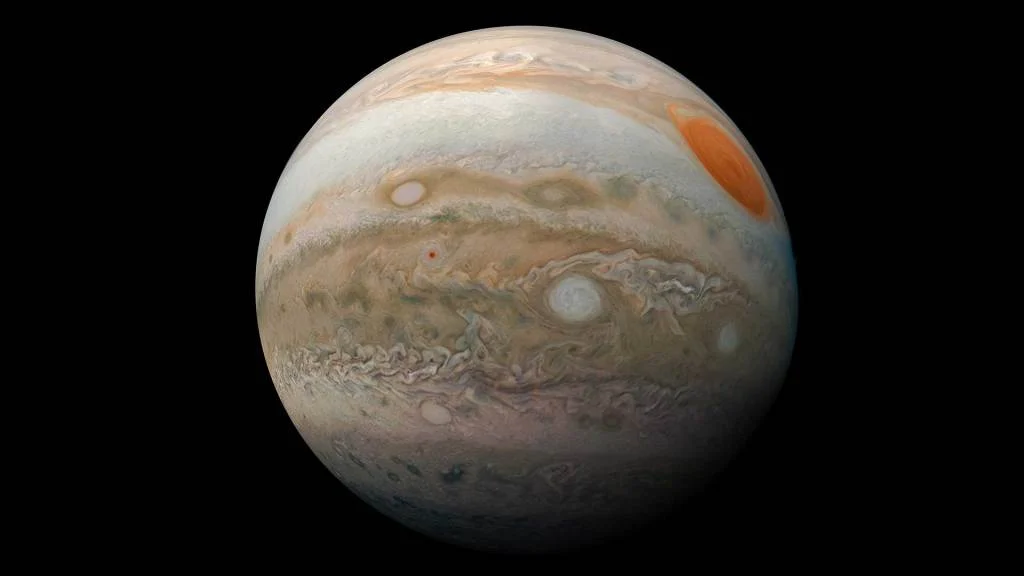
Image: NASA / JPL-Caltech / SwRI / MSSS. Processed mission imagery; apparent color varies with filters and processing.
Jupiter quick facts
| Planet type | Gas giant |
|---|---|
| Equatorial diameter | 142,984 km (88,846 mi) |
| Mean radius | 69,911 km (43,441 mi) |
| Size compared with Earth | 11.21× as wide · 1,321.3× the volume |
| Equatorial circumference | 449,197 km (279,118 mi) |
| Surface area | 6.14 × 10¹⁰ km² |
| Volume | 1.43 × 10¹⁵ km³ |
| Mass | 1.90 × 10²⁷ kg (317.9 Earth masses) |
| Mean density | 1,326 kg/m³ (1.33 g/cm³) |
| Surface gravity | 23.1 m/s² (2.36× Earth) at 1 bar |
| Escape velocity | 59.5 km/s |
| Length of day (solar) | 9.9 hours |
| Rotation period (sidereal) | 9.9 hours |
| Orbital period (year) | 4,331 Earth days (11.86 Earth years) |
| Mean distance from the Sun | 778.5 million km (483.7 million mi) · 5.2 AU |
| Closest and farthest from the Sun | 740.6 – 816.4 million km |
| Distance from Earth | 588.5 – 968.5 million km |
| Sunlight travel time | 43.3 minutes |
| Mean orbital speed | 13.1 km/s |
| Axial tilt | 3.1° |
| Mean temperature | -110 °C at 1 bar |
| Known moons | 95 |
| Ring system | Yes |
Reference: NASA Planetary Fact Sheet. Rounded values; diameters are equatorial, area and volume use the mean radius. Moon counts include discoveries announced through 2025 (such as Uranus’s S/2025 U1) and keep growing as new moons are confirmed.
How big is Jupiter compared to Earth?
Jupiter’s equatorial diameter of 142,984 km makes it 11.21 times wider than Earth. By volume, about 1,321 Earths could fit inside it. Its mass is 317.9 times Earth’s, so its average density is similar: 1,326 kg/m³ (1.33 g/cm³).
Earth’s equatorial diameter is 12,756 km (7,926 miles). See every planet to scale ↗
What is the gravity on Jupiter?
Gravity on Jupiter is about 23.1 m/s² at the 1-bar level in its atmosphere: 2.36 times Earth’s 9.8 m/s². Someone who weighs 100 lb on Earth would weigh about 236 lb on Jupiter. To escape its pull, a rocket needs 59.5 km/s.
Calculate your weight on Jupiter ↗How far is Jupiter from the Sun and Earth?
Jupiter orbits an average 778.5 million km (483.7 million miles, 5.2 AU) from the Sun, ranging from 740.6 to 816.4 million km. Sunlight takes 43.3 minutes to get there. Its distance from Earth varies from about 588.5 to 968.5 million km.
Time sunlight’s journey ↗How long is a day and a year on Jupiter?
A solar day on Jupiter lasts 9.9 hours, and one spin relative to the stars takes 9.9 hours. A year — one trip around the Sun at 13.1 km/s — lasts 4,331 Earth days (11.86 Earth years). Its axis is tilted 3.1°.
Watch the orbit ↗Is Jupiter a gas giant?
Yes. Jupiter is a gas giant made mostly of hydrogen and helium. It has no solid surface to stand on, so its “surface” gravity and temperature refer to the 1-bar pressure level in its atmosphere. Jupiter and Saturn are the solar system’s two gas giants.
Meet all eight planets ↗Jupiter questions, answered
How big is Jupiter compared to Earth?
Jupiter is 142,984 km (88,846 miles) wide at its equator, 11.21 times wider than Earth. By volume, about 1,321 Earths could fit inside it, and its mass is 317.9 times Earth’s.
What is the gravity on Jupiter?
Gravity on Jupiter is about 23.1 m/s² at the 1-bar level in its atmosphere, or 2.36 times Earth’s. Someone who weighs 100 lb on Earth would weigh about 236 lb there; escape velocity is 59.5 km/s.
What is the mass of Jupiter?
Jupiter has a mass of about 1.90 × 10²⁷ kg, or 317.9 Earth masses. Its mean density is 1,326 kg/m³ (1.33 g/cm³).
How far is Jupiter from Earth?
The distance changes as both planets orbit the Sun. Jupiter comes within about 588.5 million km of Earth and can be as far as 968.5 million km away. It orbits 5.2 AU from the Sun on average.
How long is a year on Jupiter?
One orbit takes about 4,331 Earth days (11.86 Earth years). A solar day on Jupiter lasts 9.9 hours.
Is Jupiter a gas giant?
Yes. Jupiter is a gas giant made mostly of hydrogen and helium. It has no solid surface to stand on, so its “surface” gravity and temperature refer to the 1-bar pressure level in its atmosphere. Jupiter and Saturn are the solar system’s two gas giants.
What is the density of Jupiter?
Jupiter’s mean density is 1,326 kg/m³ (1.33 g/cm³). Earth’s is 5,514 kg/m³.